





How to care for a duvet cover?

Caring for a duvet cover varies depending on its fabric: while cotton is particularly easy to maintain, other materials like cotton double gauze, silk, linen, or cotton percale require more precautions.
To keep your bedding long-lasting, we recommend following the washing and drying instructions specific to each fabric.
How to properly wash a duvet cover?
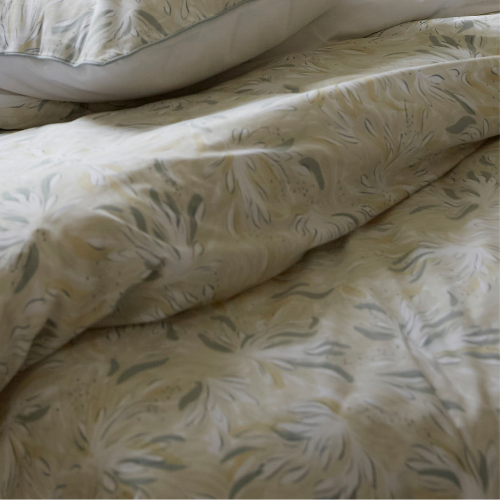
At Sylvie Thiriez, we offer a wide range of duvet covers made of natural fibers, machine washable at a minimum of 30°C. We advise you to choose the washing cycle temperature depending on the fabric of your bedding. You can use your washing machine’s pre-programmed cycles such as “cotton,” “delicates,” or “synthetics.” However, to develop good habits, here is an overview of washing instructions by fabric type. For cotton, linen, or percale models, you can select a 60°C program. Conversely, a cotton gauze duvet cover requires a maximum temperature of 40°C. If you chose a silk model, select a 30°C cycle with slow spin and use detergent specially made for silk or delicate fabrics. When in doubt, always refer to the washing instructions on the product’s label.
Whatever the material, always turn your duvet cover inside out before washing to preserve its original color. Ideally, opt for natural detergents, especially when caring for linen bedding. Simple mixtures based on Marseille soap, white vinegar, or baking soda will often be enough to tackle stubborn stains or unpleasant odors. Also, avoid overloading your washing machine as much as possible to clean your bedding more effectively.
Learn more: How to properly wash a duvet cover?
How to dry a duvet cover in a tumble dryer?
It is perfectly possible to dry your cotton duvet cover at moderate temperature in the tumble dryer. For other fabrics, it is recommended to prioritize air drying as much as possible, preferably outdoors: this applies to linen, cotton gauze, or percale models. However, you can still use the tumble dryer provided you select a low-temperature program to avoid creases. Warning: it is strongly discouraged, if not forbidden, to dry a silk duvet cover in a tumble dryer. Also, avoid prolonged exposure to sunlight for linen or silk models, which may fade.
In general, it is advised not to overload your tumble dryer, to close the opening of your duvet cover or at least fold it onto itself to prevent it from balling up or your pillowcases from slipping inside.
Before storing your cotton, washed cotton or cotton percale bedding, we recommend ironing it at medium temperature. You may, if you wish, iron your linen duvet cover at moderate heat, but this is optional since some appreciate its naturally wrinkled look. Likewise, it is generally unnecessary to iron bedding made of cotton gauze or percale after washing. Finally, it is recommended to iron your silk duvet cover when it is turned inside out and still damp; select a low temperature to avoid damaging it. Now you know the basics of caring for a duvet cover, from washing to drying to ironing! All that remains is to fold it carefully and tuck it away in a cool, dry place until next use. We recommend refreshing your bedding care every one to two weeks to keep it fresh and bright.
Learn more: How to dry a duvet cover in a tumble dryer?

You may also be interested in:
How to choose a duvet cover? | Which duvet cover size to choose? | How to put on a duvet cover?| What is a duvet cover?