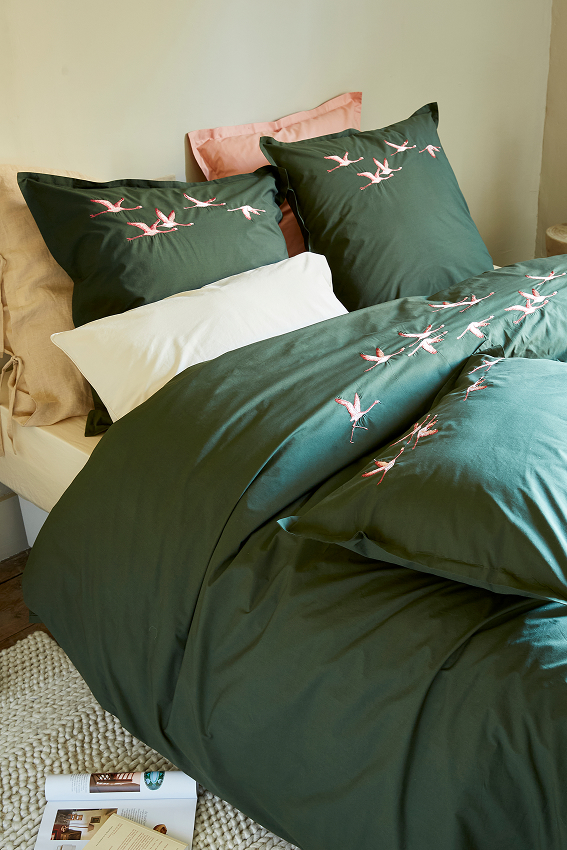





What is a duvet cover?
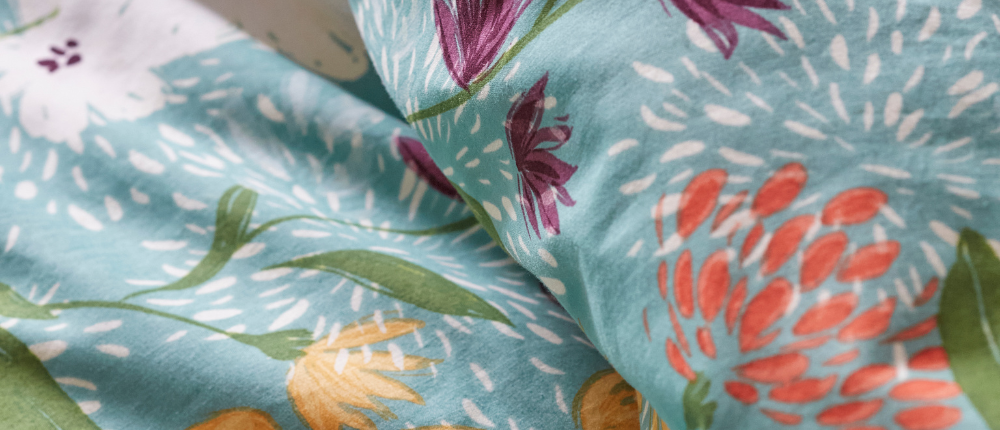
Need advice on choosing and caring for your new duvet cover? Sylvie Thiriez guides you in selecting the right model and size for your duvet cover and advises you on the best way to wash, dry and iron your bed linen.
How to choose a duvet cover?
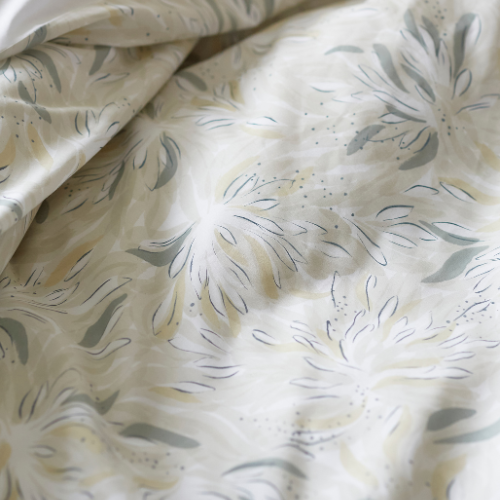
Several criteria should be taken into account. First of all, make sure you choose a model that matches the dimensions of your duvet and your bed.
Next, you will need to identify the fabric best suited to your needs and the season.
Our advice: opt for high-quality textiles, ideally natural fabrics such as cotton, linen, percale or silk, known for their breathability and durability.
For your child’s bedroom, choose cotton, which helps regulate body temperature and prevents your little one from feeling too cold or overheating under the duvet.
Finally, choose the style and colour of your duvet cover according to your bedroom decor to create a warm and cosy sleeping area.
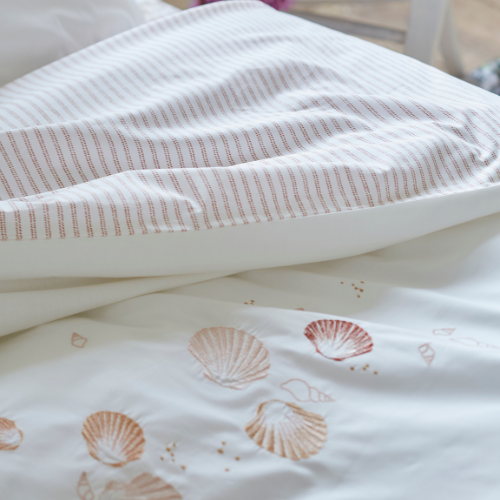
Some reversible models allow you to alternate freely between a plain side and a printed side.
→ Learn more: How to choose a duvet cover?
Which duvet cover size should you choose?
This choice depends on the size of your duvet and your bed.
For a single bed (90×190 or 90×200 cm), choose a 140×200 cm duvet cover.
A square 200×200 cm model is suitable for a 120×190 cm bed, as well as 140×190 and 140×200 cm beds.
Similarly, a 240×220 cm duvet cover can be used for a standard or queen-size bed (160×200 cm).
The largest size available is 260×240 cm: it is suitable for queen and king-size beds as well as adjustable head and foot beds.
For a child’s bedroom, choose a 80×120, 140×200 or 200×200 cm model.
→ Learn more: Which duvet cover size should you choose?
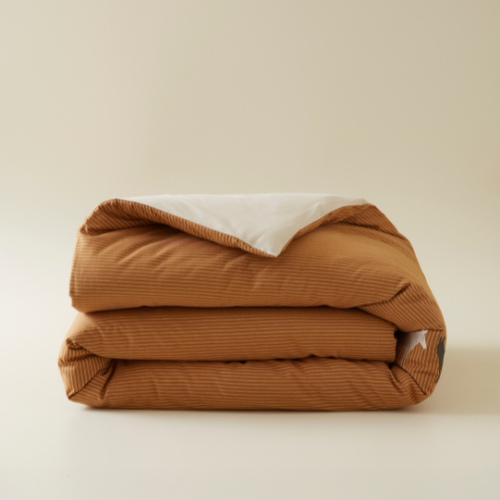
How to care for a duvet cover?

One golden rule for caring for your duvet cover: check the fabric and follow the specific care instructions!
Some textiles, such as cotton, can be machine-washed at 60°C and tumble-dried at a moderate temperature, while others require more care.
While linen or percale duvet covers can be washed at 40 or 60°C, you should not exceed 40°C for cotton gauze and 30°C for silk products.
Air drying is recommended, preferably outdoors, for these more delicate fabrics, which dry quickly.
If necessary, select a low-temperature cycle to avoid damaging your duvet cover.
However, a silk duvet cover should never be tumble-dried.
Laid flat, it will dry in just a few hours in the open air.
You can iron a cotton duvet cover at medium to high heat; choose a low temperature for silk or cotton percale bed linen.
Do you have a washed percale, linen or cotton gauze model? Good news: ironing is optional for these naturally crinkled fabrics.
In general, avoid overloading your washing machine, separate colours, and wash your bed linen every one to two weeks to keep it fresh and vibrant.
→ Learn more: How to care for a duvet cover?
How to put on a duvet cover?
To put on your duvet cover, one of the most common techniques is to grab one of the top corners of your duvet and insert it into the corresponding corner of the cover, then do the same with the bottom corner.
If two people are making the bed, one can handle the left side of the duvet while the other takes care of the right side.
That said, this technique can also be used solo: simply start with one side and then move on to the other.
All that remains is to shake the duvet cover while holding the ends firmly to keep the duvet in place.
There are also other methods, such as the rolling technique or inserting the duvet from the inside out.
→ Learn more: How to put on a duvet cover?
You may also be interested in these articles:
What is a pillowcase? | What is a fitted sheet? | What is a bed sheet?